
Fly control across Gauteng
A house fly walks from the bin to your sandwich, liquefies a crumb with its saliva and leaves a speck behind. In a home that is a nuisance; in a kitchen, a bakery, a butchery or a factory it is a contamination route and an audit finding. Ecopoise's registered operators treat flies for homes and for businesses that must pass a food-hygiene inspection.
Which fly is it?
- House fly. Grey, under a centimetre, four dark stripes on the back. Breeds in manure, garbage, grass clippings and rotting fruit and vegetables, and in hot summer weather can go from egg to adult in as little as seven to ten days. A female lays several batches of 100 to 150 eggs, and the adults can fly several kilometres from where they bred, so the source may not be on your property.
- Blow flies. The shiny metallic green and blue ones. They breed in dead animals, and some species (the latrine blowflies) breed around houses in pit latrines, septic tanks, animal manure and waste tips. They find a dead animal within minutes to hours, often from far off. A sudden crowd of big metallic flies indoors usually means a dead rat or bird in a ceiling or wall void.
- Flesh flies. Large, grey, three stripes instead of four, a chequered abdomen and red eyes. Their eggs hatch inside the female, so she deposits live maggots on carrion and dung; indoors they point to a small animal carcass in a roof or wall.
- Drain flies. Small, hairy, moth-like, resting on the bathroom wall and hopping rather than flying. The larvae live in the slime inside drains, seldom-used toilets, floor drains and septic tanks.
- Fruit flies. Three millimetres, red eyes, hovering around fruit bowls, bins, bottles, mops and drains. About 500 eggs per female and a generation in a week to twelve days; numbers peak in late summer and autumn.
- Fungus gnats. Tiny, dark, mosquito-like, rising from pot plants. The larvae live in damp potting soil. A nuisance, not a hazard.
-
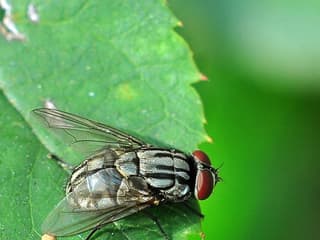 House flyMusca domesticaGrey, 6 to 7 mm, four dark stripes down the back.
-
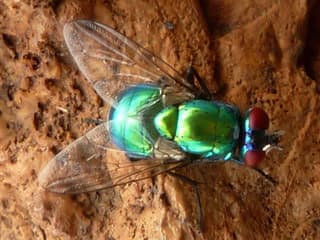 Blow flyLucilia cuprinaBlow flies come shiny green, blue or copper; the family breeds in carrion, bins, latrines and manure. This one, Lucilia cuprina, is a carrion and sheep blowfly photographed in Pretoria.
-
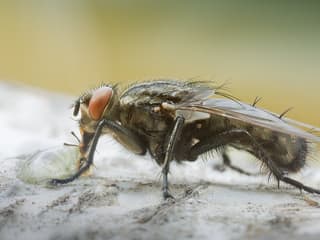 Flesh flySarcophagaGrey with three black stripes, a chequered abdomen and red eyes; deposits live maggots on carrion.
-
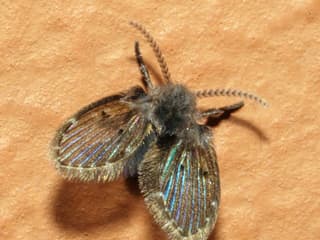 Drain flyClogmia albipunctataUp to about 5 mm, hairy and moth-like, wings held like a roof; hops rather than flies.
-
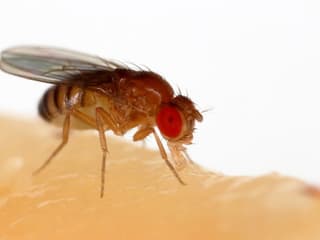 Fruit fly (vinegar fly)Drosophila melanogasterAbout 3 mm, red eyes, tan front and dark rear; fruit bowls, bins, bottles and drains.
-
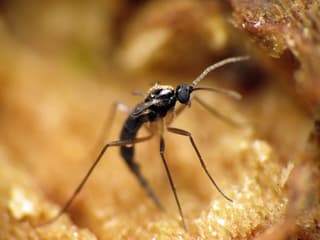 Fungus gnatSciaridae1.5 to 3 mm, dark and mosquito-like; the larvae live in damp potting soil.
The photos are a guide, not a diagnosis. Species vary, and a technician on site will confirm which one you have.
What flies carry
A house fly feeds by spitting onto solid food to liquefy it, and it defecates as it goes; it carries germs on its feet and body and in what it regurgitates and defecates onto food. A systematic review of 99 studies found more than 130 disease-causing organisms on house flies, mostly bacteria, with antibiotic-resistant strains among them. House flies are known mechanical carriers of the agents of typhoid, cholera, salmonella, dysentery and eye infections, and the World Health Organization lists flies among the ways trachoma spreads. Blow flies carry germs the same way, straight from carrion, faeces and garbage to food. The dark specks on walls and light fittings are their droppings and regurgitation.
Food businesses: what the law requires
Regulation R638 of 2018, under the Foodstuffs, Cosmetics and Disinfectants Act, applies to every business premises, stall or vehicle that handles, prepares, transports or sells food (private households are exempt). It requires food premises to be pest proof and to have effective means of controlling and preventing the access of flies, cockroaches and other insects; it makes the person in charge responsible for effective measures to prevent or eliminate flies, other insects, rodents and other pests, and for showing compliance through records; it requires ready-to-eat food to be protected from insects and meat in transit to be protected from dust and flies at all times. Municipal environmental health practitioners inspect, and the certificate of acceptability on your wall depends on it. A contravention is an offence, and a health hazard can bring a prohibition order on the spot. Internationally, the Codex General Principles of Food Hygiene make pest control a prerequisite that every HACCP plan assumes. Every Ecopoise visit comes with a service report for your records. See pest control for your business.
Finding the source
Traps and sticky boards tell you what is flying, not why. No trap alone gives satisfactory control; the breeding site has to be found and removed. Lidded bins and a clean bin area, drains cleaned of their slime, a dead rodent taken out of the ceiling, fruit kept covered, grass clippings and manure cleared: fix the source, or the programme only counts the flies.
Signs
- Fly specks on walls, ceilings and light fittings, easiest to see on light surfaces.
- A sudden swarm of large grey or metallic flies indoors: a dead animal in a void.
- Small hairy flies on the walls near drains, hopping when disturbed.
- Tiny flies hovering over fruit, bins and bottles, worst in late summer.
What Ecopoise does
- Registered operators. Registered pest control operators with the Department of Agriculture; certified members of SAPCA and PCFSA.
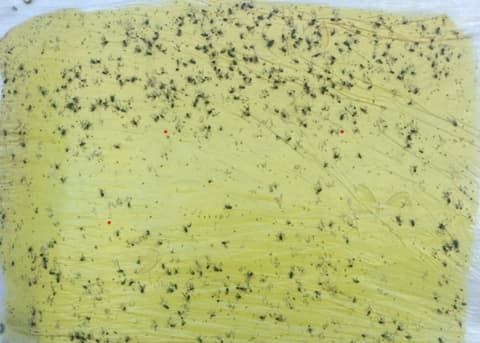
- Fly monitors. Sticky boards placed on the premises measure how heavy the fly infestation is.
- A programme that fits the site. Flies are treated on a repeating programme: weekly at food businesses, every two weeks at other contract sites, and monthly at homes. On each visit the structures and the hot spots where flies gather are treated, fly bait goes onto the surfaces where they rest, and where there are insect light traps the glue boards are replaced.
- Guarantee: fewer flies, in writing. We guarantee a reduction in the fly population, not their total disappearance, because flies also come from neighbouring properties that we cannot treat.
- Price. There are no set prices, because the price depends on the size of the area to be treated. Every job is quoted first.
Questions people ask
Why are there suddenly dozens of big flies in one room?
Almost always a dead animal, often a rat or a bird, in the ceiling or a wall void. Blow flies and flesh flies find a carcass within hours and the maggots emerge as adults about two to three weeks later, sooner in a hot ceiling, inside the house.
Will a light trap or fly paper solve it?
They help you see what is flying and catch some of it. No trap alone gives satisfactory control, because the breeding site keeps producing flies. The source has to be found and removed.
Our health inspector found flies. What now?
Regulation R638 makes the person in charge responsible for effective fly control and for the records that prove it. A pest-control programme with visit reports, plus the housekeeping fixes the technicians recommend, is what the inspector wants to see at the next visit.
Can I just send you a photo?
Yes. Send us a clear photo on WhatsApp. Nine times out of ten we can tell you what it is; when we cannot, we send it to an entomologist. WhatsApp it to 078 900 1536.
Sources and photo credits
Sources: Government Gazette 41730, Regulation R638 of 22 June 2018 (read in full); University of California IPM Pest Notes 7457 (flies, 2015) and 7448 (fungus gnats, 2013); Purdue Extension E-7-W (2018); Colorado State University Extension 5.502 (2025); University of Kentucky ENTFACT-615 and 621 (2026); Rognes and Paterson, African Entomology 2005 (South African blow flies); Khamesipour and others, BMC Public Health 2018 (the pathogen review); WHO trachoma fact sheet (2026); FAO/WHO Codex General Principles of Food Hygiene; Wikipedia, "Housefly", "Calliphoridae" and "Flesh fly" (read 30 Oct 2026). Ecopoise keeps the full fact bank with every reference.
Identification photos, via Wikimedia Commons, cropped and resized: House fly: Joydeep (JDP90) (CC BY-SA 3.0); Blow fly: JMK (CC BY-SA 4.0); Flesh fly: Richard Bartz (CC BY-SA 2.5); Drain fly: Jerzystrzelecki (CC BY-SA 4.0); Fruit fly (vinegar fly): Sanjay Acharya (CC BY-SA 4.0); Fungus gnat: Katja Schulz (CC BY 2.0). The licence names link to the full licence text.


Seen the signs? Call or WhatsApp 078 900 1536
All of Gauteng.