
Wasp nest removal across Gauteng
A grey paper comb hanging under the eaves, a wasp at every braai from February on, little mud tubes behind the picture frame. Most of the wasps around a Gauteng home leave people alone unless their nest is threatened, but a nest by the back door, the pool or a child's window is a nest in the wrong place. Ecopoise's registered operators deal with wasp nests at homes and businesses across Gauteng.
Which wasp is it?
- Paper wasps. The common nest around a house: a single open comb hanging by a stalk under the eaves, a rock overhang or a branch, made of chewed wood fibre and saliva: a round umbrella in Polistes, a longer hanging comb in Belonogaster. Colonies are small, from a handful of wasps to a few dozen, rarely more than a couple of hundred. They generally attack only when they or the nest are threatened, and then they defend it with very painful stings that they can deliver again and again. Near Johannesburg the native Belonogaster paper wasps start their nests in August, raise new queens from February, and the colony dies out as winter comes.
- Mud daubers. Solitary wasps that build rows of mud tubes on walls, under roofs and inside houses, and stock each cell with paralysed spiders for their young. Not normally aggressive; stings are uncommon. One South African mud dauber stocks its nest only with button spiders.
- Spider-hunting wasps. The big, solitary, long-legged wasps that drag a paralysed rain spider or baboon spider across the lawn. They have no nest to defend and feed on nectar themselves.
- German wasp (the yellowjacket). Black and yellow, nesting underground or in roof spaces and vents, in colonies of thousands, and it stings readily if disturbed. It is an invader confined, on current records, to a small part of the Western Cape (Cape Town and the Boland, and since 2024 the Cederberg); it has never been recorded in Gauteng. Steady wasp traffic into a hole in the ground or a vent is its pattern, so if you see that here, send us a photo.
- Bees are different. A honey bee swarm or hive is not a wasp job. Legitimate bee removers are registered beekeepers who relocate the colony alive, and ARC bee researcher Mike Allsopp puts it plainly: there is no such thing as a colony that cannot be removed alive. Beware of anyone who quotes a low price and arrives with a can of poison. Ecopoise does not treat bees: we have a beekeeper who removes and relocates them, so call us anyway.
-
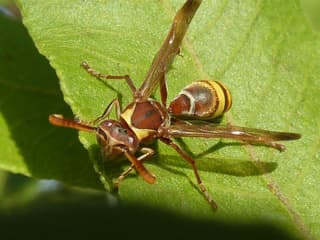 Paper waspPolistes fastidiosusThis one, photographed in Pretoria, is reddish-brown with yellow bands. Paper wasps defend the comb but otherwise rarely sting.
-
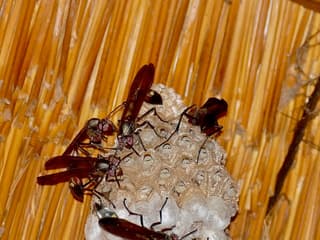 Paper wasp nestBelonogasterOne open comb on a stalk, cells facing down, under thatch, eaves or an overhang; small colonies.
-
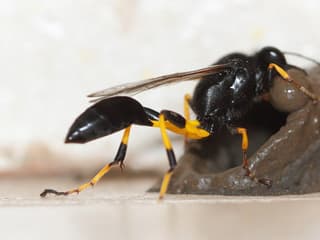 Mud dauberSceliphron spirifexBlack with yellow-and-black legs and a long yellow thread of a waist; builds rows of mud tubes on walls and ceilings, alone.
-
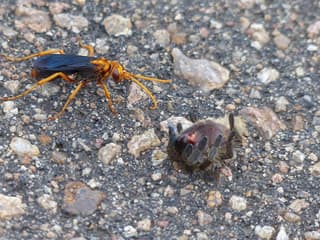 Spider-hunting waspHemipepsis tamisieriLarge, dark, long-legged and solitary; drags a paralysed spider off to a burrow. No nest to defend.
-
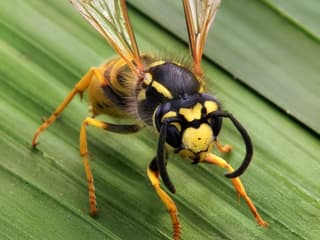 German waspVespula germanicaBlack and yellow, black antennae, about 13 mm, nests underground or in roof spaces. Western Cape only on current records.
-
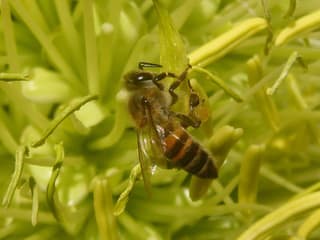 Honey beeApis mellifera scutellataNot a wasp and not a job for poison: Ecopoise's beekeeper removes and relocates the colony alive.
The photos are a guide, not a diagnosis. Species vary, and a technician on site will confirm which one you have.
Why late summer is the worst
From spring to midsummer a colony is growing and the workers hunt protein, mostly other insects, to feed the larvae. By late summer the colony is at full size and has stopped growing, and when caterpillars run short the workers turn to sugar: nectar, ripe fruit, a sweet drink left open. Raiding the braai meat and the bins is the German wasp's habit in the Cape, not our paper wasps'. That is when a nest that has hung unnoticed since August becomes a problem.
Stings
- Only female wasps sting; the sting is a modified egg-laying tube. It has no barbs, so unlike a honey bee a wasp can sting repeatedly, especially one trapped inside clothing.
- For most people a sting hurts, swells and itches for a few days. Wash it with soap and water, hold a cold compress on it for at least twenty minutes, raise the limb, and take paracetamol or ibuprofen for the pain and an antihistamine for the itch. Do not scratch.
- Get emergency help for swelling of the lips, mouth, tongue or throat, fast or wheezy breathing, a tight throat, sudden confusion, drowsiness or dizziness, pale, grey or blue skin, or fainting. Up to 7.5 percent of people have a body-wide reaction to insect stings, and about half of the fatal reactions on record happened to people with no previous serious reaction.
- See a doctor urgently if stung in the mouth, throat or near the eyes, if stung many times, or after a previous serious reaction.
Signs
- An open paper comb on a stalk under eaves, overhangs, railings or branches, growing through the summer.
- Mud tubes or cells on walls, ceilings and sheltered corners, inside and out.
- Wasps at ripe fruit, sugar-water feeders and sweet drinks from late summer.
- Steady traffic into a hole in the ground or a vent: not expected in Gauteng, so worth a photo.
What Ecopoise does
- Registered operators. Registered pest control operators with the Department of Agriculture; certified members of SAPCA and PCFSA.
- Registered products, used to the label. Wasps are treated with registered products according to their labels: the technicians spray the surfaces where the wasps come into contact.
- Guarantee: 2 months, in writing.
- Price. There are no set prices, because the price depends on the size of the area to be treated. Every job is quoted first.
Questions people ask
Can I knock the nest down myself?
Paper wasps defend a threatened nest with repeated, very painful stings, and a nest at head height by a door is the worst place to find that out. If the nest is small, out of the way and nobody in the house is allergic, it can be left to die out in winter. If it is where people pass, call us.
Will they come back next year?
Paper wasp and yellowjacket colonies normally live one season. The colony dies in winter and new queens that overwintered in shelter start fresh nests in spring.
There are bees in my wall. Do you remove them?
Not with poison. Ecopoise has a beekeeper who removes bees and relocates the colony. Call or WhatsApp us and we put you in touch.
Can I just send you a photo?
Yes. Send us a clear photo on WhatsApp. Nine times out of ten we can tell you what it is; when we cannot, we send it to an entomologist. WhatsApp it to 078 900 1536.
Sources and photo credits
Sources: WaspWeb, Iziko Museums of South Africa (Simon van Noort), on paper wasps, Polistes, the German wasp, mud daubers and spider wasps; University of California IPM Pest Notes 7450 (yellowjackets and other social wasps, 2012); Veldtman, Daly and Bekker, Insects 2021, and Veldtman in The Conversation (2024) on the German wasp in South Africa; Keeping, University of the Witwatersrand (Ethology 1990, Journal of Insect Behavior 1997), on Belonogaster petiolata near Johannesburg; Nel, Kelly and Dippenaar-Schoeman 2014 (the button-spider mud dauber); NHS, "Insect bites and stings" (2023); Assmus 2021 and Bilo and Bonifazi 2009 on sting allergy; GroundUp (2022) on bee removal; Wikipedia, "Paper wasp", "Polistes", "Belonogaster petiolata", "Vespula germanica", "Mud dauber", "Spider wasp" and "Stinger" (read 30 Oct 2026). Ecopoise keeps the full fact bank with every reference.
Identification photos, via Wikimedia Commons, cropped and resized: Paper wasp: JMK (CC BY-SA 3.0); Paper wasp nest: Bernard Dupont (CC BY-SA 2.0); Mud dauber: Alan Manson (CC BY 4.0); Spider-hunting wasp: Bernard Dupont (CC BY-SA 2.0); German wasp: Richard Bartz (CC BY-SA 2.5); Honey bee: JMK (CC BY-SA 4.0). The licence names link to the full licence text.


Seen the signs? Call or WhatsApp 078 900 1536
All of Gauteng.