
Mosquito control across Gauteng
The whine at two in the morning, the bites on your ankles, the gutter and the forgotten bucket that have been breeding them for a week. Gauteng is not a malaria area, but its house mosquitoes bite from dusk to dawn, and in wet summers the Highveld sees Sindbis and West Nile fevers. Ecopoise's registered operators treat mosquitoes for homes and businesses across Gauteng.
The mosquitoes in Gauteng homes
- House mosquitoes (Culex). The common house mosquito and its southern cousin: pale brown, three to seven millimetres, most active from dusk to dawn and resting by day in cool, dark, humid plants. They breed in dirty standing water: blocked gutters, cesspits, storm drains, leaking septic tanks, buckets and tyres. At a trapping study in central Pretoria, half the mosquitoes caught were the common house mosquito, and the rest were close relatives.
- Yellow fever mosquito (Aedes aegypti). Recorded across Gauteng in low numbers. It lives near people and bites by day, indoors and out, and it lays its eggs on the inner wall of containers just above the water line, where they survive dry for up to eight months and hatch when rain or a sprinkler covers them.
- Asian tiger mosquito. Not established in South Africa.
- Malaria mosquitoes. The Anopheles species that carry malaria in South Africa do not occur in Gauteng; the Anopheles that do live here do not transmit it. See below.
-
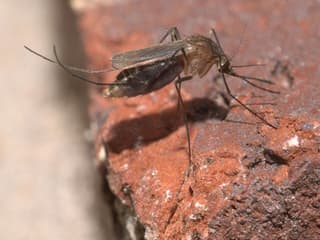 House mosquitoCulex quinquefasciatusPale to light brown with pale bands across the abdomen, about 4 mm; rests with the body parallel to the surface; bites from dusk.
-
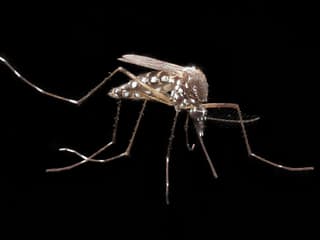 Yellow fever mosquitoAedes aegyptiSmall, black and white, with a lyre-shaped silver marking on the back and white-marked legs; bites by day.
-
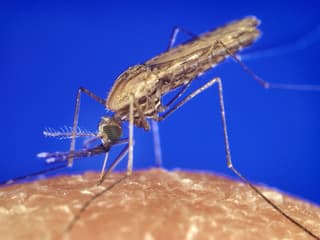 Malaria mosquito (Anopheles)Anopheles gambiaeRests and feeds with the tail end tilted up, at an angle to the surface. The malaria-carrying Anopheles do not occur in Gauteng. Shown: Anopheles gambiae, a close relative of South Africa's main carrier, Anopheles arabiensis.
-
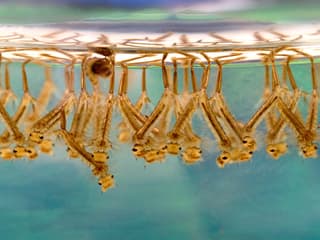 Larvae (wrigglers)CulexHang from the surface of standing water to breathe; adults in 7 to 10 days.
The photos are a guide, not a diagnosis. Species vary, and a technician on site will confirm which one you have.
Gauteng is not a malaria area
The National Institute for Communicable Diseases puts it plainly: Gauteng is not malaria-endemic, and malaria-transmitting mosquitoes do not occur here. Malaria is transmitted in the low-lying parts of Limpopo, Mpumalanga and northern KwaZulu-Natal, mostly from September to May. Gauteng hospitals still see cases every year, 414 confirmed in the first three months of 2026, but almost all were picked up in those provinces or abroad; the rare exception is 'odyssean malaria', from an infected mosquito carried into Gauteng by road or air. A fever after a visit to a malaria area needs a doctor, and the doctor needs to know where you were.
The fevers the Highveld does get
- Sindbis fever is widely distributed on the Highveld, spread by night-biting Culex mosquitoes, chiefly Culex univittatus, a cousin of the house mosquito. It causes a mild fever with a distinctive, often itchy rash and, in some people, joint pain that can linger. The NICD reports no deaths from it. The 1974 epidemic, in the Karoo and Northern Cape after unusual rains, caused about 4,000 Sindbis cases; the Highveld had its own outbreaks in 1983 to 1984 and 2004, and cases were confirmed in Johannesburg in 2017.
- West Nile fever is carried by the same mosquitoes from birds to people. Four in five infected people have no symptoms, most of the rest a mild fever, and fewer than one in a hundred a severe illness.
- Rift Valley fever is mainly a disease of livestock, caught by handling sick animals and only occasionally from a mosquito.
- Dengue is not transmitted in South Africa; the cases diagnosed here, most of them in Gauteng, are travellers who caught it abroad. Chikungunya turns up only in returning travellers (its last local outbreaks were in the Lowveld in the 1970s).
The three that occur here peak in summer, especially after good rains.
Why there are suddenly so many
Only the female bites; she needs blood to produce eggs. A house mosquito lays a raft of 100 to 300 eggs on standing water, and in warm weather the egg becomes a biting adult in seven to ten days. So a gutter, a birdbath, a blocked drain or a bucket left out in the rain is a mosquito factory within a week to ten days. In a four-year trapping study across northern South Africa, Gauteng included, mosquito catches were lowest in the dry months, June to October, and highest from November to mid-April, rising after each rain. The itch is a reaction to the proteins in her saliva that stop your blood clotting while she feeds; she finds you by the carbon dioxide you breathe out, your body heat and your smell.
Signs
- Whining and bites at night: house mosquitoes. Bites by day, often on the lower legs: an Aedes mosquito. Several day-biting Aedes species live on the Highveld; the yellow fever mosquito is one of them, in low numbers.
- Wrigglers hanging just under the surface of standing water, diving when the water is disturbed.
- Adults resting by day under leaves, in dense shrubs, in dark sheds and under eaves.
What Ecopoise does
- Registered operators. Registered pest control operators with the Department of Agriculture; certified members of SAPCA and PCFSA.
- The water they breed in. Standing water is treated with the products Ecopoise uses in water, according to their labels.
- The surfaces they rest on. The technicians spray the surfaces where mosquitoes may come into contact.
- Guarantee: fewer mosquitoes, in writing. We guarantee a reduction in the mosquito population, not their total disappearance, because mosquitoes also come from neighbouring properties and water that we cannot treat.
- Price. There are no set prices, because the price depends on the size of the area to be treated. Every job is quoted first.
Questions people ask
Is there malaria in Gauteng?
No. Gauteng is not a malaria area and the mosquitoes that carry malaria do not occur here. Almost every case treated in Gauteng hospitals was caught in Limpopo, Mpumalanga, northern KwaZulu-Natal or abroad; very rarely an infected mosquito arrives by road or air.
Why do most of them bite at night?
The house mosquitoes that dominate Gauteng are active from dusk to dawn and hide by day in cool, dark, damp plants. The yellow fever mosquito, recorded here in low numbers, bites by day.
Where are they breeding?
In standing water on or near your property: blocked gutters, storm drains, cesspits and septic leaks, buckets, tyres, birdbaths, flowerpot saucers, toys and bins. Once a week, empty and scrub, turn over, cover or throw out anything that holds water.
Can I just send you a photo?
Yes. Send us a clear photo on WhatsApp. Nine times out of ten we can tell you what it is; when we cannot, we send it to an entomologist. WhatsApp it to 078 900 1536.
Sources and photo credits
Sources: National Institute for Communicable Diseases, malaria statement (22 Apr 2026), malaria FAQ (2024), Sindbis fever and West Nile fever FAQs (2022), arbovirus alert (2017), Rift Valley fever, dengue and chikungunya pages; Gauteng Department of Health (2014); US EPA on the mosquito life cycle (2026); US CDC on Culex and Aedes mosquitoes (2024, 2025) and prevention (2024); Taioe and others 2020 (the Pretoria trapping study); Guarido and others, Parasites and Vectors 2021; Cornel and others 2003; Meno and others, Frontiers in Microbiology 2022; WHO on West Nile virus (2017); ECDC on the Asian tiger mosquito; Wikipedia, "Mosquito", "Culex pipiens" and "Culex quinquefasciatus" (read 30 Oct 2026). Ecopoise keeps the full fact bank with every reference.
Identification photos, via Wikimedia Commons, cropped and resized: House mosquito: Robert Webster (CC BY-SA 4.0); Yellow fever mosquito: Graham Snodgrass, US Army Medicine (CC BY 2.0); Malaria mosquito (Anopheles): James Gathany, CDC (Public domain); Larvae (wrigglers): James Gathany, CDC (CC BY 2.5). The licence names link to the full licence text.


Seen the signs? Call or WhatsApp 078 900 1536
All of Gauteng.